Chronic illness doesn't allow much room for rebellion. It takes people from all backgrounds and walks of life and forms them into a homogeneous group - patients.
The life of a patient with chronic illness is filled with constant reminders of illness: not just symptoms, but regular (and as required) medications, special diets and regular monitoring, both at home and in hospitals/clinics. There's not much wiggle room in this sort of lifestyle.
I have medications that are taken every 4, every 6, every 8, every 12 and every 72 hours. 21 different ones, in fact. Some of them have to be taken with food; others on an empty stomach. Some medications are fine when taken in combination with other medications; some have to be taken at least a couple of hours apart.
These medications, in addition to their desired effects on my tumbledown body, have so many side effects. I'm sure I'm not alone in having medications to treat the effects of other medications. Less serious considerations include drowsiness (Promethazine works beautifully for me, but knocks me out completely for approximately 12-15 hours), nausea, abdominal pain, dizziness and tachycardia. It's not always possible, but as far as I can, I try to take these medications when I don't need to drive, be alert (and/or awake), or alone. Just for fun, our stairs are entirely open on one side, so tackling the stairs is not something to be done when drowsy or dizzy!
I am supposed to monitor my weight, calorie and fluid intake, blood sugar, peak flow (a measure of how restricted my airways are), oxygen saturations, blood pressure, pulse and temperature every day. I also have a special (and very restrictive) diet that I have to follow.
I have braces for my shoulders (including slings), wrists, elbows, knees, ankles and feet. I have a selection of crutches, sticks and wheelchairs.
This is my reality. Every single day.
There are days when this feels far, far too much, and I get an overwhelming desire to escape from all of it - from the symptoms and from all the medications, the testing, and the medicalness of it all.
I owe my life to many of the medications that I take, and know that not taking these would win me at least a week or so in hospital. I don't want to take medications, but my desire to stay out of hospital is even greater. So I divide my medications into two categories: essential and optional. The latter category is mainly made up of painkillers and supplements. Missing a dose or two of these is bad, but not bad enough to land me up in hospital. So, when I'm feeling rebellious and as though I can't stand to take any more medication, I don't take these meds.
Yes, this causes pain, but I can convince myself that it's worth it just for that moment of freedom from medications. This is what normality feels like, right?
Showing posts with label medication. Show all posts
Showing posts with label medication. Show all posts
Monday, 27 February 2012


Monday, 6 February 2012
When Even Liquids are a Struggle: Some Advice
Gastroparesis is a condition in which the muscles or nerves of the stomach don't work correctly so the stomach isn't able to empty effectively. Food stays in the stomach for hours longer than it should, causing nausea, bloating, fullness and pain, as well as vomiting.
Because the stomach doesn't empty properly, eating and drinking can be a battle to fight through all the symptoms. Failure to eat or drink enough can cause severe malnutrition and/or dehydration.
One of the easiest things to do when gastroparesis symptoms are severe is to stick to a liquid diet. Liquids empty from the stomach by gravity, so in theory they should cause fewer symptoms than solids. However, even liquids can cause symptoms, so here are a few tips as to how you can maximise nutrition when even liquids are a struggle.
Website: livingwithgastroparesis.com
Books: Living (well!) with Gastroparesis
Eating for Gastroparesis: Guidelines, Tips & Recipes
I'd love to hear from you about any other websites or books that you recommend, or any tips that you find helpful when eating and drinking are a struggle.
Because the stomach doesn't empty properly, eating and drinking can be a battle to fight through all the symptoms. Failure to eat or drink enough can cause severe malnutrition and/or dehydration.
One of the easiest things to do when gastroparesis symptoms are severe is to stick to a liquid diet. Liquids empty from the stomach by gravity, so in theory they should cause fewer symptoms than solids. However, even liquids can cause symptoms, so here are a few tips as to how you can maximise nutrition when even liquids are a struggle.
- Maximise your nutrition and hydration - make every morsel count. Now is not the time for diet drinks.
- Take care of your teeth - chew sugar-free gum to hydrate your mouth and don't brush your teeth within 20 minutes of vomiting. Yes, this feels disgusting, but the acid in vomit softens the tooth enamel, and if you brush too soon, you'll remove precious enamel from your teeth. Rinse your mouth with water immediately, and then brush later.
- Take your anti-emetics (anti-sickness drinks) on a regular schedule. If you can keep the nausea and vomiting at bay, you have a better chance of staying hydrated
- If swallowing is a problem, or if you don't absorb tablets/capsules well, speak to your GP or pharmacist about alternative preparations. Many anti-sickness medications are available as tablets that dissolve in the mouth, or even as a patch that can be stuck on the skin. Other medications may be available as liquids or soluble tablets (or other forms), and capsules can sometimes be opened and the tiny beads inside can be swallowed with a spoon of yoghurt or apple sauce.
- Get help for pain, whether it is in your mouth, throat, stomach, or somewhere else. Bonjela (a gel for teething pain or mouth ulcers) is available over the counter. Don't be afraid to speak to your GP or pharmacist about pain, especially if it's stopping you from eating or drinking.
- Painkillers are better at keeping pain at bay than they are at getting pain under control once it's really established itself. If you've been prescribed painkillers to take regularly, do take them regularly.
- If you've been prescribed NSAIDs (e.g. Aspirin, Ibuprofen, Naproxen, Diclofenac) and find that they are upsetting your stomach, ask your GP or pharmacist if they can recommend an alternative, or if they really are the best medications for you, to prescribe other medication to protect your stomach while you're taking the NSAIDs.
- Be careful of low blood sugars (hypoglycaemia). Symptoms of hypoglycaemia include anxiety, nausea, sweating, hunger, shakiness and weakness. If you find it difficult to spot the symptoms of low blood sugars before they get so low that you collapse in a heap, ask your GP about monitoring your own blood sugars at home, and make sure you get instructions about when you should check your sugars, how low is too low, and what you should do in this situation.
- Taking a supplement of multivitamins/minerals can minimise some of the anxiety associated with not being able to eat. If you know that your micronutrient needs are being met, you can focus on getting hydration and calories. I recommend trying to find supplements in liquid or chewable form, as these are often better tolerated than capsules or tablets. Those designed for children can be more palatable. If you can't tolerate the whole dose, or can't tolerate it every day, don't give up. A little is better than nothing!
- Water is great, but if you're barely managing liquids, your body may need more than just water - try clear liquids, e.g. apple juice, cranberry juice, bouillon, sugary cordials. It's also possible to buy fortified juices, such as Fortijuice, which are clear liquids, but are fortified with extra nutrients and calories.
- Dioralyte (or another rehydration solution) is brilliant if you can tolerate it, as it contains electrolytes and sugars to help replenish what you're losing, especially if you're vomiting or if you have diarrhoea.
- Try setting a timer - every 15 minutes drink a teaspoon full of liquid. This seems like a tiny amount, but if you can tolerate it, you'll be getting 20 ml per hour, or 100 ml every five hours. It all adds up. If you can manage that, try increasing the frequency to every 10 minutes, or the volume to 2 tsp (10 ml).
- Carry a bottle of juice around with you and take a sip every time you remember.
- Using a straw can make it easier to drink quantities, especially if you have a sore mouth.
- Very plain salty crackers, e.g. saltines or water biscuits can help settle the stomach
- Ice lollies (popsicles) are a great way to get those valuable liquids. They are available in minature forms for children, but if even these are too large, try making ice cubes from fruit juice or cordials.
- Ginger is renowned for its anti-nausea properties. A delicious tea can be made from grated ginger, honey and hot water. Strain before drinking.
- Boiled sweets (hard candy) are a good source of sugar. If you can suck these in addition to your liquid diet, they provide calories, flavour and a bit of variety from an entirely liquid diet.
- Get yourself some dextrose tablets to have on hand in case of low blood sugars - you can suck them or rub them against your gums. If you prefer, you can get sugary gel from your pharmacist that has the same effect (try Hypofit or Dextrogel).
Website: livingwithgastroparesis.com
Books: Living (well!) with Gastroparesis
Eating for Gastroparesis: Guidelines, Tips & Recipes
I'd love to hear from you about any other websites or books that you recommend, or any tips that you find helpful when eating and drinking are a struggle.
Saturday, 3 December 2011
Being a Helpful Patient
There is certain information that your doctors will always need to know. This can be as simple as your name and address and your PCP's details to more detailed information about your past medical history and the medications that you take.
I have a big medical folder of my own records (known as The Big Red Folder). This is split into sections for letters from specialists, test results, relevant publications and articles, diet sheets, exercise sheets from physio, and all sorts of other useful things. Most of the time this folder lives at home with me. It contains the charts that I showed you last week that I use to keep track of my symptoms and the medications that I take.
I am so grateful that I started compiling my medical paperwork in this way, and have learned lessons from other people with complex medical conditions. One of these lessons is to take time every 6-12 months to write to my doctors and request copies of important test results. It can be so helpful to have an MRI report and the scan itself on CD to show a new doctor, rather than having to take my word for what it showed, or waste time for them to request the results from another specialist. I have so many doctors and other health professionals working with me that it can be really hard to keep track of all the tests and all the results. I am the only person who knows about every test and every appointment, so I feel a sense of responsibility to keep good records.
Right at the front of my Big Red Folder is a section of essential information. This is an 'executive summary' that covers all the most important points in my medical history. I have been asked so often by doctors in the ER if they can borrow/photocopy this executive summary that I now carry spare copies in the folder.
So where to start? Well, think back to the last time you were in the ER. You may remember being asked the same questions over and over by the different people that looked after you. There are certain things that your doctors will always need to know.
My executive summary looks like this:
Page 1:
- My name, address and date of birth
- Next of kin details (name and contact number)
- Details of my GP (name, address, telephone)
- My height and weight (important for some drug calculations)
- A list of my most important diagnoses - no details, just the name of the diagnosis
Important contact details:
Name, address and contact details for all the specialists that care for me, including my hospital number (patient reference number) for each hospital/clinic. This list includes bleep numbers and email addresses where relevant. For example, it has the bleep number of the Specialist Registrar on-call for asthma at the Royal Brompton Hospital, which is the specialist lung hospital where I'm treated. If I'm admitted to any other hospital, it can be helpful for them to get in touch with one of my specialists as a matter of urgency.
Page 3:
- List of current medications and allergies
The rest of the page is taken up with a list of my regular and 'as required' medications. For each medication I have given the generic name (unless it's important for absorption or allergy reasons that I take a particular brand), the dose, the route, the frequency and the reason that I take it.
Make sure to include any medications that you buy over the counter, supplements that you take, and your method of contraception, if appropriate.
Page 4:
Past Medical History:
Just a list of dates and important events. For the sake of brevity, I don't include all hospital admissions, just the things that seem most relevant to me - childhood illnesses, major diagnoses, surgeries.
Page 5:
Family History:
Try to restrict this to immediate family (siblings, parents, grandparents) unless there is an inherited condition that can be seen more clearly by including more family members. Even if you don't have inherited diseases in your family, it's worth noting the causes of death of close family members and the incidence of things like diabetes, cancer and heart/lung disease.
Social History:
This is just a bit about you:
- Do you smoke (how much and for how many years)?
- Do you drink (what, how much, how often)?
- Do you take any illegal drugs? If so, what and how often?
- Do you live in a house/flat/castle? Are there stairs?
- Do you have pets/children/other dependents?
- Who looks after your care needs if you have any?
- Do you work? What do you do, how many hours do you work?
- Are you right or left handed?
That's about it for my executive summary. Of course, it's not rocket science, but it's amazing how things get forgotten in the heat of the moment. Having a printed, legible list to give to anyone treating you can relieve a lot of the pressure of acute illness (for you and your loved ones) and allow you to focus on getting the treatment you need to get better.
More on The Big Red Folder tomorrow!
Wednesday, 30 November 2011
That Fine Line
Those of us with chronic illnesses live with symptoms day in and day out. The severity of those symptoms may vary, and some of them may go away from time to time, but we never feel 'well' in the way that we would like.
In order to manage these daily symptoms, many of us have medications and treatments available to us that would usually require hospital admission: home oxygen, intravenous medications, nebulisers, strong medications. These are not cures, just ways of maintaining the status quo and allow us to stay at home with a reasonable quality of life.
Difficulties arise, however, when things deteriorate despite all the medications that we have in our 'chronic illness toolkit'.
How far should we allow things to deteriorate before we 'give in' and accept that we need extra help and support? How long do we wait for the 'rescue' medications that we have to kick in? It may be that the deterioration is gradual, and insidious, and it can seem hard to know the point in the downward trend at which we should seek advice. Worse still, we can get so caught up in just dealing with each moment as it comes that we stop looking at the bigger picture and asking how we are going to improve things.
These are difficult questions for anyone reluctant to 'bother' their doctor (or other health professional), but even more so for people with chronic illnesses. Often, our illnesses are rare, and may be complex. While the necessary treatment may be simple, getting it may be another matter.
Flare-ups often seem to happen at night or at the weekend, especially if it is a holiday weekend. This poses yet another question of whether we try to wait until we can get in touch with our own specialists, or whether we need help sooner than that. I feel as though I am treading a fine line whenever I am in the position of needing to make this decision.
Emergency Departments are not really set up to treat those of us with complex medical conditions. They are very good at what they do, which is to treat accidents and acute illness. It is unfair to expect them to be able to handle rare medical conditions.
Of course, the ideal is to be able to contact one's own specialist for advice and treatment. They are far better placed to be able to tweak routine treatment and instigate new therapies than any healthcare professional meeting you for the first time.
But what happens when you really can't get in touch with your own doctors?
Alternative communication methods:
Telephone and email can be excellent ways to get in touch with your doctors. Email, in particular, allows you to give all the relevant details, taking time to write carefully and accurately, without the panic of an emergency conversation. It also allows you and your doctor to have a written record of the enquiry and any advice given.
Having a written protocol in place for emergencies:
If your illness is of the type that might require emergency treatment, you could ask your doctor or nurse specialist to write a protocol for you to take to the Emergency Department with you. For example, if you are known to have a certain type of seizure that responds well to particular medications, this could all be put in writing, with a copy given to your local ED and another copy for you to carry around with you. In the UK, it's possible for patients to be 'flagged' with the local ambulance service, so that any paramedics called out are prepared with relevant information. MedicAlert tags and cards (and equivalent) also provide valuable information if you're not able to give details to those treating you.
Be prepared:
If you can, try to predict things that might go wrong. It's not unrealistic to think that someone with gastroparesis might have a bad flare in which they can't eat or drink, and so need IV hydration and anti-sickness medications (and possibly also gastric decompression and artificial nutrition).
The more difficult cases arise when those unpredictable flare-ups occur. Either unrelated illnesses that worsen the underlying condition, or new symptoms.
In this case, it is important to act as sensibly as possible. Get advice, either from your own healthcare providers or from someone who knows you well, rather than from an overworked out-of-hours or emergency physician, in the first instance.
If the answer is that you need medical intervention (or at least assessment), the next question is when? Can you wait until you are able to see your own doctor? Is there anything more that you can do at home to keep things as stable as possible while you wait?
If the answer to 'when?' is 'now', then you have to ask 'where?' -
1. Out of hours GP service
2. Walk-in (or minor injuries) unit
3. Emergency Department (perhaps by ambulance, if necessary)
So, what are you waiting for:
Do you need help?
When do you need help?
Where are you going to get this help?
And with that, I am going to take another dose of my rescue medications now in the hope that I can delay needing help from my own doctor until tomorrow, when she is next in clinic.
Wish me luck!
This post was written as part of NHBPM - 30 health posts in 30 days: http://bit.ly/vU0g9J
Monday, 28 November 2011
Being Bedbound
The idea of being bedbound means different things to different people. In its most pure form, it means that someone is unable to get out of bed at all, and may need to lie flat for all or most of the time. More commonly, it is used to describe a situation in which someone spends the vast majority of their time in bed, though they may be able to go to the bathroom or transfer to another place to lie down.
Chronic conditions often fluctuate, meaning that while there are times when I can leave the house, and drive myself to a hospital appointment or other appointment and back, these activities tend to have repercussions, especially if I push past those warning signals that tell me I should be in bed! I'm 30 years old, and have lived with these conditions all my life. Of course I push past my warning signals sometimes!
I had a fun, productive and busy week last week. I thought that I'd paid for the excess movement when I had a 'crash day' midweek and could do nothing but sleep, but apparently not. I slept for 14 hours on Saturday night, and then spent most of Sunday horizontal on the sofa. Today has been much the same - horizontal on the sofa, packed around with pillows and duvet and hot water bottles; drugged to the eyeballs in an attempt to get control over the pain, nausea & vomiting and dizziness. I can't tell you how many attempts I've made at writing this post through the haze of medication that destroys any clarity of thought.
Ideally, on days like this, bed is the place to be.
In order to stay in bed (my snuggly prison, as my friend M calls it), I need certain supplies. When I was last properly bedbound in May of this year, I could crawl from my bed to the bathroom (though I collapsed and hurt myself a few times) but there was no way that I could make it downstairs. So I came up with the idea of having a 'snack station' for times like this.
The Snack Station is not for midnight feasts (well, maybe it is sometimes), but is a selection of snacks that I can tolerate even when my tummy is really playing up, and which allow me to remain fed and watered without getting out of bed. Several of my medications have to be either dissolved in water or taken with food, so it's important that I have food and water so that I can take the medications I need.
The essentials:
UHT skimmed milk (in small cartons - 500 ml or less)
Nesquick instant milkshake powder (this is fortified with sugar and vitamins)
Nutrigrain bars (low in fat and fibre, but relatively high in energy, and some contain pureed fruit)
Pretzels (low in fat & fibre if you get the right brand)
Snack-a-Jacks (come in lots of different flavours - low in fat & fibre)
Bottled water
Snack-size cartons of fruit juice (some have added vitamins and minerals)
For those of you in the US, Orgain is a great option as an organic liquid meal replacement. Here in the UK we have to put up with Scandishakes, Fortisip, Fortijuice, Forticreme, etc. You can ask your dietitian.
The kit:
Scissors
Dycem (sticky plastic stuff for getting a grip with weak hands)
Plastic cups
Plastic spoons
Drinking straws
Baby wipes
Paper napkins
I have been bedbound, or virtually so, for up to 6 months in the past. If that happened again, I would invest in a small kettle, microwave and refrigerator to live by my bed.
In the shorter term, I can ask Richard to bring thermos flasks of hot water and cold water upstairs before he leaves for work so that I can make myself hot drinks (bouillon and ribena are good; instant breakfast and cup-a-soups are edible in an emergency).
This list would also make a handy travel list of things that can be carried relatively easily and give a guaranteed supply of food and drink that don't provoke symptoms. Trying to find a shop in a new city or country (especially if you don't speak the local language) that will cater for a very restricted diet can be stressful. Especially if your blood sugar is tanking with every step you take!
So, it looks as though I'm confined to the Snuggly Prison for at least the next couple of days. I'm not miserable about that (it was worth it to be able to get my hair cut) but it's good to be prepared. Look out for pictures once I've set up my bedroom Snack Station!
If I'm stuck in bed for longer than a few days, you may also get some pictures of a bedroom Craft Station, but hopefully not. I have grand plans for the study...
This post was written as part of NHBPM - 30 health posts in 30 days: http://bit.ly/vU0g9J
Sunday, 27 November 2011
Blaming Myself
Among other things, I have what is known as 'difficult asthma'. This means that my asthma is severe and persistent, despite maximal medical therapy. It is par for the course that things flare up and I run out of things that I can try at home. At this point, I either try to wait it out at home, in the hope that I can keep things stable enough and give my lungs time to get their act together, or I take myself off to my local hospital. The latter option usually wins, even if I try the waiting option for a bit first.
I take my medical care quite seriously, and am careful about taking my medications and avoiding allergens and things that trigger asthma attacks.
This is a good thing, as I'm sure it helps me to avoid unnecessary hospital admissions, and means that my doctors are happy to let me leave hospital that little bit earlier, as they know I'm capable of looking after myself.
I know that I'm a 'good patient', but there's always a nagging doubt that maybe I could be doing something differently. Something better.
Articles like this one (which was published in the American Journal of Respiratory and Critical Care Medicine) suggest that difficult asthma is often nothing more than a failure on the part of the patient to take their medications as prescribed.
While I agree that it's sensible to make sure that people are taking their medication before trying additional treatments with potentially serious side-effects, this view does make me feel inadequate, or even defensive. Most of the doctors that treat me are able to see that I am committed to my medical care, but there is the occasional one who treats me as though I know nothing about my treatments, and that I'm in hospital because I'm stupid. This view manifests itself in questions about my psychological wellbeing, whether I know about and take my medications, and questions about whether I smoke or inhale other inappropriate things. Peanuts and dust, for example. Or cocaine. Having patients admit to using hardcore illegal drugs makes this type of doctor very happy.
The sense of disappointment that I feel when it becomes clear that things are deteriorating despite my best efforts is hard to describe. I have such optimism when things go well, and feel so disheartened when they don't.
I think that today's lesson is that I have an illness that fluctuates. Part of the nature of difficult asthma is that it is hard to control, and I need to be forgiving of myself when, despite my best efforts, things deteriorate. However, the fact that it is an illness full of ups and downs does not give me an excuse not to try my hardest to control it. Yes, it's disheartening when I try hard and things go wrong, and I know that even when things go right it's as much due to luck as judgement, but every good day (even every good hour) is worth the effort, and I owe it to myself to give myself every opportunity to live life to the full.
This post was written as part of NHBPM - 30 health posts in 30 days: http://bit.ly/vU0g9J
Friday, 25 November 2011
Organising Medical Supplies: After
It's taken me the best part of a week, but I'm nearly there with the organisation of the medications, and here's how I did it:
One of the two drawers under my bed is now dedicated to medications and testing equipment (oxygen saturation monitor, peak flow meter, blood glucose testing equipment, thermometer, blood pressure monitor). The other drawer will, at some point, contain splints and braces. Crutches and canes are stored in a convenient gap between my wardrobe and the wall.
What I used for the medications:

This is the bottom of the two boxes:


The drawer organisers have different medications in each. Most of my standard daily testing things fit into one compartment, which is useful. I've tried to keep similar medications near to each other, though it hasn't worked perfectly because of the size and shape of the dividers.
So there you have it - a fresh start to keeping my medications in order, which is so appropriate given that I am now trying to manage my chronic illnesses as though they are a full-time job, remember? What better way to start than to have everything in order?!


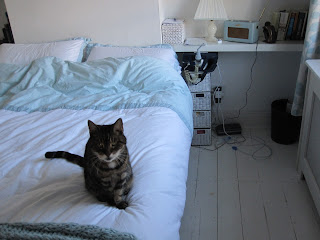
My next project is to get my medical records in order, including the charts that I've been using to keep track of my symptoms, vital signs and medication use. Oh, and I want to come up with a system to make sure that I know when my medications run out or expire so that I can order new ones at the right time.
This post was written as part of NHBPM - 30 health posts in 30 days: http://bit.ly/vU0g9J
One of the two drawers under my bed is now dedicated to medications and testing equipment (oxygen saturation monitor, peak flow meter, blood glucose testing equipment, thermometer, blood pressure monitor). The other drawer will, at some point, contain splints and braces. Crutches and canes are stored in a convenient gap between my wardrobe and the wall.
What I used for the medications:
- Two canvas drawer liners with compartments (from Ikea)
- Two clear plastic shallow boxes with dividers and lids (Ikea)
- One clear plastic deep box with dividers and lid (Ikea)

This is the bottom of the two boxes:

- Batteries (for hearing aid, portable nebuliser, TENS machine)
- Tape
- Alcohol hand gel

- Dissolvable anti-emetics (Zofran), mints, chewing gum, ginger candies,antacids
- Diclofenac (Voltarol) gel, Lorazepam, scar gel
- Epi-pen, antihistamines, hydrocortisone, glucose tablets

The drawer organisers have different medications in each. Most of my standard daily testing things fit into one compartment, which is useful. I've tried to keep similar medications near to each other, though it hasn't worked perfectly because of the size and shape of the dividers.
So there you have it - a fresh start to keeping my medications in order, which is so appropriate given that I am now trying to manage my chronic illnesses as though they are a full-time job, remember? What better way to start than to have everything in order?!


My next project is to get my medical records in order, including the charts that I've been using to keep track of my symptoms, vital signs and medication use. Oh, and I want to come up with a system to make sure that I know when my medications run out or expire so that I can order new ones at the right time.
This post was written as part of NHBPM - 30 health posts in 30 days: http://bit.ly/vU0g9J
Saturday, 19 November 2011
Big Changes Around Our House
Richard and I went to Ikea today. As you probably know, I don't get out of the house much, so this was a big excursion. It was a beautifully sunny day, so I got out the sunglasses (as well as scarf and gloves) and we put the roof down on the car. I was so happy to enjoy the late autumn sunshine with Richard!
 Our main aim was to find a cabinet or shelving system to hold the wine glasses that seem to be taking over the house. We have glasses of every conceivable shape and size - for different cocktails, spirits (cognac/armagnac, whisky) and wines - Sherry, Champagne, Chianti, Burgundy, Bordeaux, Sauvignon blanc, dessert wine and port! We were hoping to use the wall space above the sideboard in our dining room, but found something so perfect that we just had to move things to make space for it! The cello now has its own little nook under the stairs and the glass cabinet now lives between the fireplace and the piano (keyboard, really, but I call it a piano - wishful thinking!), where it looks very smart, don't you think?
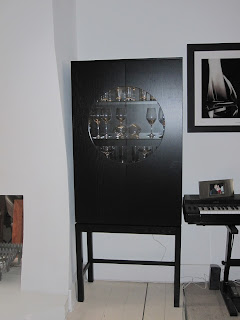
We also got lots of photograph frames for the photo wall in the study and for the hallway. You'll get to see them once they're filled with pictures and hung on the wall, but not before. I don't want to spoil the surprise for you!
Yes, I said 'study'. We are finally going to turn the laundry/junk room back into a study. Richard is going to get a desk and a filing cabinet, and we are going to reclaim the room. Richard plans to use it as a home office; I plan to use it for crafts. We'll see if those two uses can coexist happily together!
Most excitingly for me, we got some storage containers to try to organise my medications, which were in quite a state. I haven't had the energy yet to put them to use, but when I do I think it might be worth a post of its own. So many medications, pieces of equipment (nebulisers, a capella, TENS machines), testing stuff (blood pressure, oxygen saturations, temperature, blood sugar, peak flow) and crutches, canes, braces, etc. It's hard to know where to store it all, especially as I need to be able to get to most of it easily.
I've looked online for storage ideas, but I realise that most normal people don't have quite the volume of medication that I have. A small slimline cabinet on the bathroom wall is just not going to cut it!
We've got some clever ideas that I'll show you once I've finished. Or at least once I've started.
Reorganising takes a surprising amount of effort on my part. I can't lift anything much heavier than 1L of milk (that's about 33 oz, for the Americans), so I do most of the planning in my head and then ask for help with the execution. My head is full of wonderful ideas, but it might take a little while to get there. Especially as Richard works long hours and I have a remarkable ability to end up in hospital when we do have time to execute my exciting plans. But I still believe that my plans will become reality one day.
Watch this space!
This post was written as part of NHBPM - 30 health posts in 30 days: http://bit.ly/vU0g9J


 |
| Don't worry - we don't use the radiator |
Yes, I said 'study'. We are finally going to turn the laundry/junk room back into a study. Richard is going to get a desk and a filing cabinet, and we are going to reclaim the room. Richard plans to use it as a home office; I plan to use it for crafts. We'll see if those two uses can coexist happily together!
Most excitingly for me, we got some storage containers to try to organise my medications, which were in quite a state. I haven't had the energy yet to put them to use, but when I do I think it might be worth a post of its own. So many medications, pieces of equipment (nebulisers, a capella, TENS machines), testing stuff (blood pressure, oxygen saturations, temperature, blood sugar, peak flow) and crutches, canes, braces, etc. It's hard to know where to store it all, especially as I need to be able to get to most of it easily.
I've looked online for storage ideas, but I realise that most normal people don't have quite the volume of medication that I have. A small slimline cabinet on the bathroom wall is just not going to cut it!
We've got some clever ideas that I'll show you once I've finished. Or at least once I've started.
Reorganising takes a surprising amount of effort on my part. I can't lift anything much heavier than 1L of milk (that's about 33 oz, for the Americans), so I do most of the planning in my head and then ask for help with the execution. My head is full of wonderful ideas, but it might take a little while to get there. Especially as Richard works long hours and I have a remarkable ability to end up in hospital when we do have time to execute my exciting plans. But I still believe that my plans will become reality one day.
Watch this space!
This post was written as part of NHBPM - 30 health posts in 30 days: http://bit.ly/vU0g9J
Thursday, 17 November 2011
Researching a New Diagnosis
I like to consider myself an expert patient. I am familiar with the signs and symptoms of my illness, the medications used to treat it (including those that I don't take) and their interactions and side effects. I know about the non-medical and complementary therapies used to treat my illness, and manage my own treatment plan with support from my GP and specialists.
This is the result of many, many years of accumulated research.
But where should you start with a new diagnosis?
I found myself asking that very question a few years ago, when I received a new diagnosis to go alongside the existing ones.
Receiving the diagnosis was a relief, as I knew that something was very wrong, so it was helpful to have a name for it so that I could start to understand. What I found frightening was that I couldn't answer people's questions about this rare condition, couldn't suggest anything to my GP, and felt totally unfamiliar with the new medications used to treat it.
So where did I start?
Get a general overview of the condition:
www.patient.co.uk contains numerous articles about medical conditions, many of them written by doctors and for doctors. This was my starting point for looking up the primary diagnosis, and later, the other diagnoses that came along with the primary one. Get an understanding of how the illness presents, is diagnosed, is treated, and how things might progress in the future. Learn about how the illness affects the normal functioning of your body (and learn about the normal functioning if you don't already know).
Try to steer clear of websites that promise miracle cures, or that promote particular products. What you need at this early stage is thorough, reliable information, which will provide a foundation for your future expertise. The NHS website, eMedicine, and Wikipedia are all relatively reliable, though you may find some of their articles a little light on detail.
Find out more from a patient perspective:
Look for any societies or charities specifically supporting people with your diagnosis. Read their articles and message boards, ask questions and compare other people's experiences with your own. Think of this as adding colour and texture to the basic understanding that you gained from the first step above.
Medical websites can give facts and figures, but you have an advantage (?!) in that you know what it is like to actually have this condition and live with it. Reading about acid reflux, for example, without ever experiencing it, is like reading about the taste of a peach without ever eating one.
Look for published research:
PubMed was my next port of call, to see what research had been published about my condition. This is a quick step, just to see if there is anything new or on the horizon for your condition. You may not be able to access full text of research papers, but you can always ask your GP or specialist to print off articles for you, or just ask them what they think about a particular piece of research.
Find out more about drug treatments:
Patient information leaflets provided with any prescribed or over-the-counter medication are helpful. Make sure you read them, even if you don't remember everything they say. It's important to know if a new symptom could be a side-effect of medication or an interaction with another medication that you take. The BNF (British National Formulary) has more details about doses, adverse effects and interactions. Your pharmacist will have a copy and might let you borrow or keep an old edition if they have one knocking around. Try to understand what each medication does and why it has been prescribed.
Complementary and lifestyle measures:
This is probably the most difficult topic to research, as results are often anecdotal. Ask questions of other people with your condition, your GP, your therapists and specialists. Talk to complementary therapists (make sure they're registered with a recognised governing body, and get a personal recommendation if possible). Remember that your mind is very important in all of this - relaxation and meditation may be a valuable part of your treatment, along with more physical interventions, such as acupuncture, yoga, diet and exercise, osteopathy, etc. Most of all, use your common sense. Don't stop taking prescribed medications without consulting your GP, or try something that your gut tells you is risky.
Finally:
Try to keep track of your symptoms - what makes them better or worse, what effects (good and bad) you notice from the medication you are prescribed and from any lifestyle changes you make. Take every opportunity you can to learn more about your condition, participating in teaching for medical students or expert patient programmes, if they're offered to you.
This is your life; your medical condition, and you can take charge. You are the only one who can see the whole big picture of your body and how it's affected by various things (illness, food, exercise, medication, etc.), so you have the right to be the boss of your medical team. Use other people's expertise in addition to your own, but don't forget that you are the leader and the core of the team. This is your life, and you have a vested interest in living it to the very best of your ability.
This post was written as part of NHBPM - 30 health posts in 30 days: http://bit.ly/vU0g9J
Subscribe to:
Posts (Atom)